
Let’s go back to the spring of 2012.
I had just perfected my spicy peach salsa recipe. I had spent weeks sourcing the jars, designing the labels on my laptop, and figuring out how to pitch a tent without pinching my fingers. I was ready.
I walked into the market manager’s office, handed over my application, and smiled. She looked at it, flipped to the second page, and tapped a blank line with her pen.
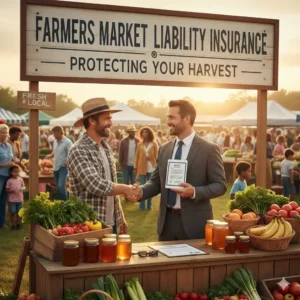
“Where is your COI?” she asked.
“My what?”
“Your Certificate of Insurance. We need to be listed as an Additional Insured before you can sell a single jar.”
My heart sank. I thought insurance was for big companies with HR departments, not for me and my salsa. I panicked. I assumed it would cost thousands of dollars and take weeks to process. I almost quit right there.
If you are reading this, you are probably holding that same application form, feeling that same knot in your stomach. You just want to sell your goods, but now you’re drowning in terms like “aggregate limits” and “indemnification.”
Take a breath.
I have helped hundreds of vendors navigate this exact moment. It is not as scary—or as expensive—as you think.
In this guide, I’m going to walk you through how to get liability insurance for farmers market vendors without getting ripped off. We will cover who to callfarmers’to buy, and how to get that certificate in your inbox by the end of the day.
Why Do You Actually Need This? (It’s Not Just Red Tape)
Before we get to the “how,” let’s briefly talk about the “why.” It’s easy to think the market manager is just being difficult, but they aren’t.
Markets are chaotic. You have wind, dogs, uneven pavement, and hot food. Accidents happen.
Here is the reality of what you are protecting:
- The “Trip and Fall” (General Liability): A customer trips over your tent leg or slips on a dropped strawberry. They broke a wrist. They sue. Without insurance, they sue you personally.
- The “Bad Batch” (Product Liability): You sell a loaf of bread. A customer claims it had a piece of glass in it, or they had a severe allergic reaction you didn’t label.
If you don’t have insurance, one lawsuit can bankrupt you, a small business and threaten your personal assets (like your car or house). The insurance policy puts a multi-million dollar shield between the world and your bank account.
The Two Types of Insurance You Need to Know
When you start shopping, you will see a lot of confusing options. Ignore 90% of them. You only care about two specific types of coverage.
1. General Liability (GL)
This covers the physical space of your booth.
- Scenario: Your tent blows over and scratches a customer’s BMW.
- Scenario: A display shelf falls on a kid’s foot.
- Standard Limit: Most markets require $1,000,000 per occurrence / $2,000,000 aggregate.
- Translation: The insurance pays up to $1 million for a single accident, and up to $2 million total for the whole year.
2. Product Liability (PL)
This covers the item you are selling.
- Scenario: Food poisoning, allergic reactions, or a handmade toy that breaks and causes injury.
- Crucial Note: If you sell food, soaps, or skin products, General Liability is not enough. You absolutely must have Product Liability.
My Advice: Never buy a policy that only covers General Liability if you sell anything edible or topical. Ensure both are included in the bundle.
How to Get Liability Insurance for Farmers’ Market (The Action Plan)
Here is your step-by-step roadmap. Follow this, and you can be insured in less than 20 minutes.
Step 1: Define Your Category
Insurance companies price risk based on what you sell. Be honest here.
- Low Risk: Artists, photographers, woodworkers, knitters. (Cheapest)
- Medium Risk: Bakers (no cream fillings), produce farmers, jam makers. (Standard)
- High Risk: Hot food vendors (cooking on-site), meat and sellers, cosmetic makers, CBD products. (Most Expensive)
Warning: If you sell homemade soap but list yourself as a “knitter” to save $20, your claim will be denied when someone gets a rash.
Step 2: Choose Your Term (Daily vs. Annual)
Do you plan to sell at one festival a year, or every Saturday for the whole season?
- Daily Policy: Costs about $49 – $79 per event. Good for one-offs.
- Annual Policy: Costs about $275 – $325 per year. Covers you 24/7/365 at any market.
The Math: If you plan to do more than 4 market days a year, buy the Annual Policy. It is infinitely cheaper in the long run.
Step 3: Pick a Provider (My Top Recommendations)
I have used or reviewed almost every carrier in the niche. Here are the three industry standards that market managers trust.
Option A: ACT Insurance (Best for Crafters)
- What is it: Artists, Crafters, and Tradesmen Insurance.
- Who it’s for: People who make non-food items. Jewellery, art, pottery, clothing.
- Pros: Very cheap annual rates (starts around $279). Instant certificates.
- Cons: They are strict about food. startu sell food, they will push you to their sister company (FLIP).
Option B: FLIP (Best for Food Vendors)
- What is it: Food Liability Insurance Program.
- Who it’s for: Bakers, farmers, salsa makers, hot dog carts.
- Pros: They understand food risk. They cover things like food poisoning, which generic business insurance might miss.
- Cost: Roughly $299 – $399/year depending on your sales volume.
Option C: Thimble (Best for Flexibility)
- W,hatWhatt: On-demand insurance via an app.
- Who it’s for: The occasional vendor or weekend warrior.
- Pros: You can buy insurance by the hour. If rain cancels the market, you can sometimes pause or cancel.
- Cons: Can get expensive if you use it every week.
Option D: Campbell Risk Management (Best for Farmers)
- Who it’s for: Growers and farmers selling raw produce.
- Pros: They specialize in agriculture and often have the best rates for pure farmers.
specialised “Additional Insureds”
This is where most people get stuck.
When you buy the policy, there will be a section that asks: “Do you need to add an Additional Insured?”
Say YES.
- Who do you add? The market management company owner (if the market is in a mall parking lot), and sometimes the city.
- The Cost: Good providers (like FLIP and ACT) offer Unlimited Additional Insureds for free.
- The Rip-Off: Some local brokers charge $25 per name. Avoid them. You will switch markets or do holiday fairs, and those $25 fees add up fast.
Step 5: Download and Email
Once you pay, you will get a PDF called the “COI” (Certificate of Insurance).
Email this directly to your market manager. Keep a printed copy in your cash box at the booth. Health inspectors and fire marshals love to ask for it.
The “Secret Sauce”: The Guild Membership Hack
I promised you a pro-tip that you won’t find in the standard brochures.
If you are finding the quotes for standalone insurance too high (especially for soap makers or candle makers), look into Professional Guilds.
Insurance companies love groups. They offer massive discounts to trade associations because they are buying in bulk.
Example:
- Handcrafted Soap & Cosmetic Guild (HSCG): If you join this guild, their member-exclusive insurance deal is often significantly better than buyits policy on the open market.
- Indie Business Network: Similar setup for crafters and makers.
The Strategy:
Check the membership fee of the guild + the cost of their insurance.
Often: (Membership + Insurance) < (Standalone Insurance Quote).
Plus, you get the networking, education, and “Certified Member” logos to put on your website. It’s a win-win.
4 Rookie Mistakes to Avoid
I’ve seen vendors make these errors and regret it later. Save yourself the headache.
1. Underestimating Gross Sales
Your prthemium is often based on how much you sell.
- Mistake: Estimating $10k in sales to get a cheaper rate, then actually selling $50k.
- Consequence: If you have a claim, the insurance company can audit you. If they see you lied about your volume, they can deny coverage or back-charge you. Be realistic.
2. Skipping the “Inland Marine” Coverage
Standard liability covers lawsuits. It does not cover your stuff.
If your expensive Square Terminal gets stolen, or your tent flies away and breaks, liability pays you $0.
- The Fix: Ask for “Inland Marine” or “Business Personal Property” coverage. It usually costs an extra $50-$100/year and covers your gear.
3. Using Homeowners Insurance
“I have home insurance, can’t I just use that?”
NO.
99% of homeowners policies specifically exclude “business activities.” If you burn homeowners’ with soup, your home insurance agent will laugh at you. You need a commercial business policy.
4. Waiting Until Friday Night
Market managers are busy. If you email your COI at 11:00 PM on Friday for a Saturday morning market, they might not see it. If they don’t see it, you don’t set up.
Buy your policy at least 72 hours before your first market.
Conclusion: It’s the Cost of Doing Business
I know it feels like throwing money away. Writing a check for $300 when you haven’t sold a single tomato yet is painful.
But flip your perspective.
That $300 isn’t just a fee; it’s your sleep-at-night tax.
When you are standing in your booth, chatting with customers, the wind is blowing, and kids are running around, you don’t want to be nervous. You want to be focused on selling.
knowing you are covered allows you to be a professional. It tells the markeKnowinger you are serious. It tells your customers you are legitimate.
So, open a new tab. Go to one of the providers I mentioned. Fill out the form. It will take you 15 minutes.
Then, get back to the kitchen (or the workshop). You have inventory to prep.
Go get insured.
Frequently Asked Questions
1. How fast can I get a certificate?
With modern online providers like FLIP or ACT, it is instant. As soon as your credit card processes, the PDF is in your email. You can literally do it from your phoneis processedarket parking lot (though I don’t recommend waiting that long!).
2. Is farmers market insurance tax deductible?
Yes! It is a 100% necessary business farmer’s. Keep the receipt-deductible to your accountant at tax time. It lowers your taxable income.
3. Does my LLC protect me? Why do I need insurance?
This is a common misconception. An LLC (Limited Liability Company) separates your personal assets from your business assets. If you get sued, they can take the business’s money but not your house. However, an LLC doesn’t pay for lawyers. Insurance pays for the defence attorney and the settlement. You need both.
4. Can I share a policy with my booth partner?
Generally, no. The policy covers the business entity. Unless you and your friend have formed a legal partnership (like a joint LLC), you are two separate businesses sharing space. If her product hurts someone, your insurance won’t cover her.
5. What if I sell at multiple markets?
If you buy the Annual Policy, you are covered at all of them. You just need to log into your dashboard and add each new market as an “Additional Insured” and email them the certificate. There is usually no extra cost for this