Let’s cut the fluff and be real for a minute.
I still remember the pit in my stomach when I bought my first car. It was a rusty Honda Civic that smelled like old French fries. I was fresh out of college, totally broke, and terrified to call an insurance agent.
Why? Because I was convinced that just asking for a price would cost me money. I imagined a taxi meter running the second I picked up the phone, or that checking my options would somehow trash my credit score.

If you are sitting there clutching your credit card, wondering if you need to pay a fee to see what a policy costs, I’ve got the answer you need.
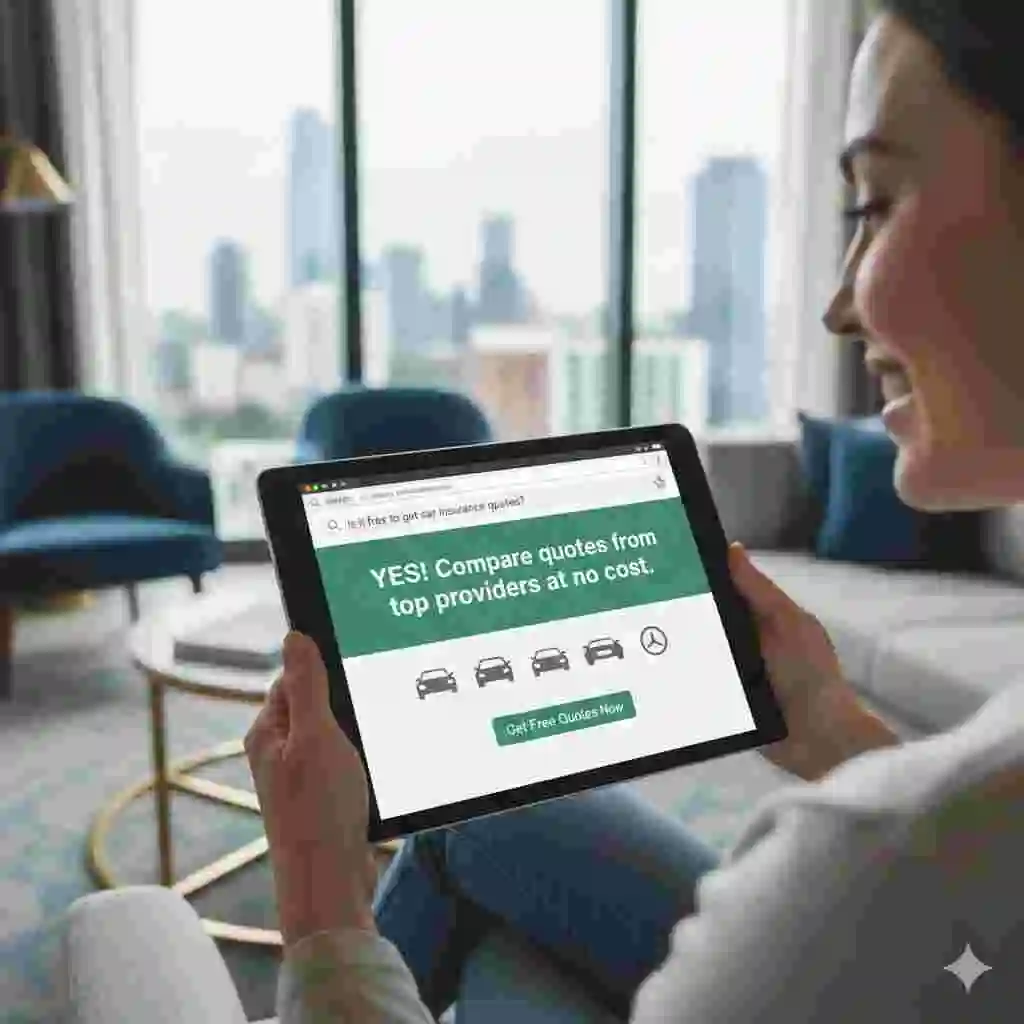
Is it free to get car insurance quotes?
Yes. Always.
I’ve been in this game for over 10 years. I have never—not once—seen a legit company charge a penny for a quote. If someone on the phone asks for a credit card number to give you an estimate? Hang up. You’re being scammed.
But here is the kicker: Getting the quote for free is the easy part. The hard part is making sure that the “free” quote doesn’t turn into a headache of spam calls or a cheap policy that leaves you stranded when you actually crash.
So, grab a drink. I’m going to walk you through how this works, why it’s free, and—most importantly—how to manipulate the system to save hundreds of dollars.
Why Are Quotes Free? (The Real Reason)
You might be thinking, “Why would these billion-dollar companies waste time giving me a price if I haven’t paid them yet?”
It’s simple. You are the product.
A quote is just a fancy word for a “sales lead.” Carriers are fighting a war for your business. They want you to switch. Charging you for a quote would be like a grocery store charging an entry fee—nobody would go in. They want zero friction.
They are banking on the fact that if they give you a number fast enough, you’ll just say “yes” without reading the fine print.
The Big Credit Score Lie
This is the number one thing people panic about.
“If I get five different quotes, will my credit score tank?”
No.
When an insurer looks at your credit to set your rate, they do a Soft Pull.
- Hard Pull: This is for loans or credit cards. This does hurt your score.
- Soft Pull: This happens when you check your own score, or an insurer checks it for a quote. This has zero impact.
You could get 50 quotes in a single afternoon, and your credit score wouldn’t drop a single point.
The Hidden Cost of “Free” (Watch Out)
While the quote costs $0.00, it usually costs you something else: your privacy.
If you go to those generic websites that shout “Compare Rates Now!”, you aren’t actually getting quotes. You are selling your data. Those sites take your name and phone number and auction them off to 10 different agents in your zip code.
Five minutes after you hit “submit,” your phone is going to melt down with sales calls.
The “Burner” Strategy
Here is my pro-move to keep your sanity:
- Make a Junk Email: Create something like
DaveShopping4Insurance@gmail.com. Use this for all your quotes so your main inbox doesn’t get clogged with junk. - Use a Google Voice Number: It’s free. If the agents get annoying, you can mute that specific number without blocking your grandma.
7 Ways to Save Money (The Action Plan)
Now that we know it’s free to look, let’s stop looking at the price tag and start changing it.
Most people think the price is set in stone. It’s not. Insurance is a game of risk. If you look less like a risk, you pay less money.
Here are 7 ways to legally lower your rate that I use for my own family.
1. The “21-Day” Rule
Timing is everything.
If you wait until the day your policy expires to shop around, insurers view you as “desperate” or “disorganised.” Statistically, disorganised people crash more cars. (Crazy, right?)
I’ve run the numbers a thousand times. The sweet spot is 21 to 26 days before your renewal date.
Shopping three weeks early can save you up to 10% just because the computer algorithm flags you as a “responsible planner.”
2. Compare Apples-to-Apples
When you call for a quote, the agent will try to sell you a “cheaper” policy. Often, it’s only cheaper because they gutted your coverage.
Do this instead:
- Find your current policy’s Declarations Page (the sheet with all the numbers).
- Send that to the new agent.
- Tell them: “Match these limits exactly.”
Only then can you see who is actually cheaper.
3. Be Honest About Mileage
Work from home? Retired?
If you told your insurer five years ago that you drive 12,000 miles a year, but you really only drive 6,000 now, you are overpaying.
Rates are heavily based on how much you are on the road. Call your agent and update your annual mileage. Dropping into a lower mileage bracket is the fastest way to trigger a price drop.
4. Fix Your Deductible
Here is a hard truth: Insurance is for catastrophes, not parking lot scratches.
If you have a $250 deductible, you are paying extra for the privilege of filing small claims. But filing small claims raises your rates. It’s a lose-lose.
Raise your deductible to $500 or $1,000.
- The Math: Raising your deductible usually drops your monthly bill by 15% to 30%.
- The Strategy: Take the money you save each month and throw it in a savings account. In two years, you’ve saved the difference, and the rest is pure profit.
5. The Bundle Trap
Everyone knows you should bundle Home and Auto. It’s the oldest trick in the book.
But here is what they don’t tell you: Sometimes the bundle is a rip-off.
A company might have great auto rates but terrible home rates. Even with the “bundle discount,” you might pay more total than if you kept them separate.
The Plan:
- Quote the bundle.
- Quote Auto only.
- Quote Home only.
Do the math. Don’t assume the bundle always wins.
6. Dig for “Affinity” Discounts
Insurers love groups. They assume that if you belong to a certain group, you drive more safely.
You might be missing out on discounts for:
- Alumni Associations: Did you graduate from a state uni?
- Credit Unions: Are you a member?
- Jobs: Engineers, teachers, and nurses often get special rates.
- Grades: If you have a teen driver with a ‘B’ average, send that report card in immediately.
Ask the agent: “Read me the full list of affinity discounts.” Make them do the work.
7. The Tracking Device (Telematics)
You’ve seen the ads: “Plug this device in and save 30%!”
This is Usage-Based Insurance. It tracks your braking, speed, and phone usage.
My honest take:
If you drive like a grandma, do it. The savings are real.
If you drive in rush hour traffic (lots of hard braking) or have a heavy foot, skip it. Some companies will actually raise your rates if the data shows you drive aggressively. Know yourself before you plug it in.
The “Secret Sauce”: The Ghost Shopper Method
I promised you a tip that you won’t find on page one of Google. This is something insiders do, but regular folks rarely think of.
I call it the Ghost Shopper Method.
When you get a quote, the system asks for your VIN. But what if you are thinking about buying a different car?
Most people buy a car and then check the insurance. That is a financial disaster waiting to happen.
The Pro Move:
Before you buy your next vehicle, grab the VINs of 3 similar cars from Autotrader.
- Car A: Toyota Camry
- Car B: Honda Accord
- Car C: Subaru Legacy
Run quotes on all three.
You will be shocked. I once had a client debating between a Honda and a Hyundai. The Hyundai was $40 cheaper per month to insure because the parts were cheaper to replace.
That’s $480 a year in savings just by picking the right car before signing the paperwork.
Who Should You Call?
Since it is free to get quotes, where do you go?
1. The Big Names (Direct Writers)
Think Geico or Progressive.
- Good: Fast apps, easy to use.
- Bad: They can only sell their own stuff. If their rate goes up, their only advice is “sorry.”
2. The Brokers (Independent Agents)
These are local agencies that represent 20 different companies.
- Good: They do the shopping for you. If one company raises rates, they move you to another one next year without you lifting a finger.
- Bad: Sometimes their tech is a bit old school.
My Advice:
Get one quote online from a big name to see the baseline price. Then, call a local Independent Broker. Give them your numbers and say, “Can you beat this?” Let them fight for your money.
What You Need (The Checklist)
To make this fast, have these ready before you start:
- Driver’s License Numbers: For everyone in the house.
- VINs: Or at least the exact Make, Model, and Year.
- Current Policy: The Declarations Page.
- SSN: (Optional, but recommended).
- Note: You can get a quote without your Social Security Number, but it won’t be accurate. Since credit is a huge factor, giving them your SSN ensures the price they show you is the price you actually pay.
The Bottom Line
So, is it free to get car insurance quotes? 100%.
But the real value isn’t that the quote is free. The value is that you are in control.
Insurance companies bank on your laziness. They profit when you set up autopay and forget about it for five years. They slowly creep your rate up, hoping you won’t notice.
Don’t let them win.
Here is your homework:
- Make that burner email today.
- Find your current policy.
- Get three quotes this week.
It will take you less than an hour, and for most people, it puts about $500 back in their pocket. That’s a pretty good hourly wage, right?
You’ve got this. Go save some money.
FAQ
Does getting a quote mean I have to buy?
Nope. You can get a quote, look at it, and throw it in the trash. No contract until you sign.
Why are the prices so different?
Each company likes different risks. Company A loves families; Company B loves single drivers. If you get a high price, you just aren’t their “type.” Move on.
Online or Phone?
Usually, the price is the same. But calling a human can sometimes uncover hidden discounts that an online bot misses.
How often should I check?
Check every 12 months, or whenever you have a big life change (marriage, moving, new car)